
Diamond refractive top coat delivers light-reactive brilliance without texture grit.
A medium-viscosity polymer seal loaded with micronized optical prisms. It cures smoothly under 36W to 48W UV/LED lamps, producing high-impact sparkle in flash photography while remaining completely flat to the touch.
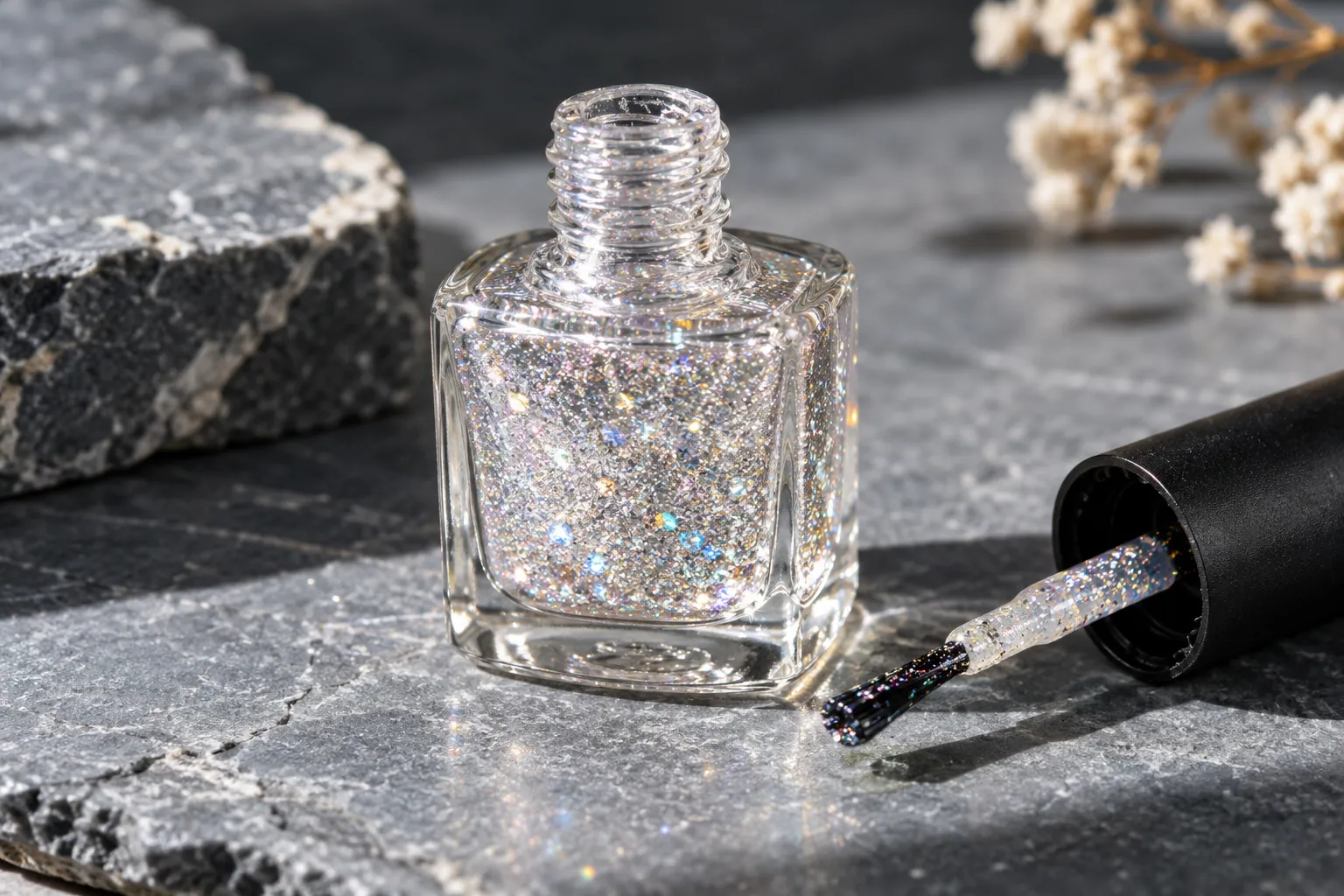
| Parameter | Laboratory Spec |
|---|---|
| Capacity & Vessel | 10 ml heavy amber UV-blocking glass bottle |
| Viscosity Index | Medium elastic gel • self-leveling within 4 seconds |
| Curing Protocol | 60s under 48W LED • 120s under 36W UV lamp |
| Dispersion Layer | Zero • true no-wipe formula (no alcohol rub required) |
| Glitter Density | 0.08 mm faceted aluminum-borosilicate prisms |
| Removal Method | Buff off top layer; soak off or electric e-file carbide |
Settling occurs when manufacturers mix heavy polyester flakes into thin monomer solvents. Our Diamond Refractive Top Coat uses a thixotropic polyurethane acrylate base calibrated precisely to suspend 0.08 mm borosilicate prisms indefinitely. You do not shake this bottle; you roll it between your palms twice.
The resin levels out in four seconds after stroke placement, burying each optical particle underneath a glass-smooth surface. You never need an intermediate clear gel layer to smooth down rough foil corners.
Many optical glitters use cheap nitrocellulose that oxidizes into a dingy amber cast after five days in sunlight. This formulation incorporates targeted UV-absorber chemistry (stabilized bis-ethylhexyloxyphenol) that blocks yellowing on pure white French manicures and sheer milk bases.
Tested under intense salon tanning lamps and direct southern sun for fourteen days: the background color retained its original CIE L*a*b* coordinates with zero discernible warmth or tint shift.
Every bottle dispatched from our 130 North Tryon Street studio carries its physical batch lot printed on the underside, cross-referenced with a dated manufacturer Certificate of Analysis. We inspect bottle seals, brush alignment, and cap torque before staging.
Our practitioner has managed bench operations since 2022. We do not source liquid closeouts, unverified mystery decants, or expired stock lots. If a bottle arrives with a defective neck or bristle bend, our replacement desk issues immediate credit.
Application Protocol for Diamond Refractive Top Coat
Follow these exact workbench steps to achieve maximum optical sparkle and avoid heat spikes or premature edge chipping.
Pigment Base Curing & Dust Inspection
Ensure your color coat or nail art is fully polymerized under LED light. Gently wipe any stray airborne lint with a dry non-woven wipe. Do not use alcohol on tacky dispersion layers if your base color is dark.
Gentle Bottle Agitation & Bead Loading
Roll the 10 ml amber bottle between palms for twenty seconds. Wipe the brush stem against the inner bottle neck, leaving a controlled droplet on one bristle side only.
Floating Application Across the Apex
Place the bead 1 mm away from the proximal nail fold. Float the brush down towards the free edge with light brush pressure, allowing surface tension to distribute refractive particles without dragging.
Self-Leveling & Dual-Wavelength LED Cure
Allow four seconds for the resin to achieve a mirror plane. Cure immediately for 60 seconds in a 48W UV/LED lamp. Allow twenty seconds of post-cure cooling before touching the surface with cuticle oil.
This product is engineered strictly for UV/LED gel systems. It will not air-dry and cannot be cured under basic incandescent desk lamps. If you seek a quiet matte finish, choose our Velvet Suede Matte Top Coat ($13 USD) instead.
If you require an ultra-thick apex sculpting gel for nail extensions, use our Dense Rubber Base Coat ($14 USD). Diamond Refractive Top Coat is a finishing seal, not an architectural builder gel.
Inquire for Diamond Refractive Top Coat
Submit your bottle quantity or combined order inquiry. Non-binding quotation provided by our studio desk within one business day.