Catalogue Item GLS-BASE-RB-15Natural Plate Alignment15 ml Glass Bottle
Dense rubber base coat creates an elastic self-leveling structural apex on natural nails.
Formulated for technicians and home manicure practitioners confronting thin, ridged, or mechanically stressed nail plates. Where watery primers pool into cuticles, high-viscosity rubber polymer stays where placed while surface tension levels ridges in under twenty seconds.
Current Unit Price$14 USD per 15 ml bottle
Category Range$7 to $16 USD per piece
Curing Benchmark60s UV/LED (48W lamp)
Order ModeCatalog Inquiry Only
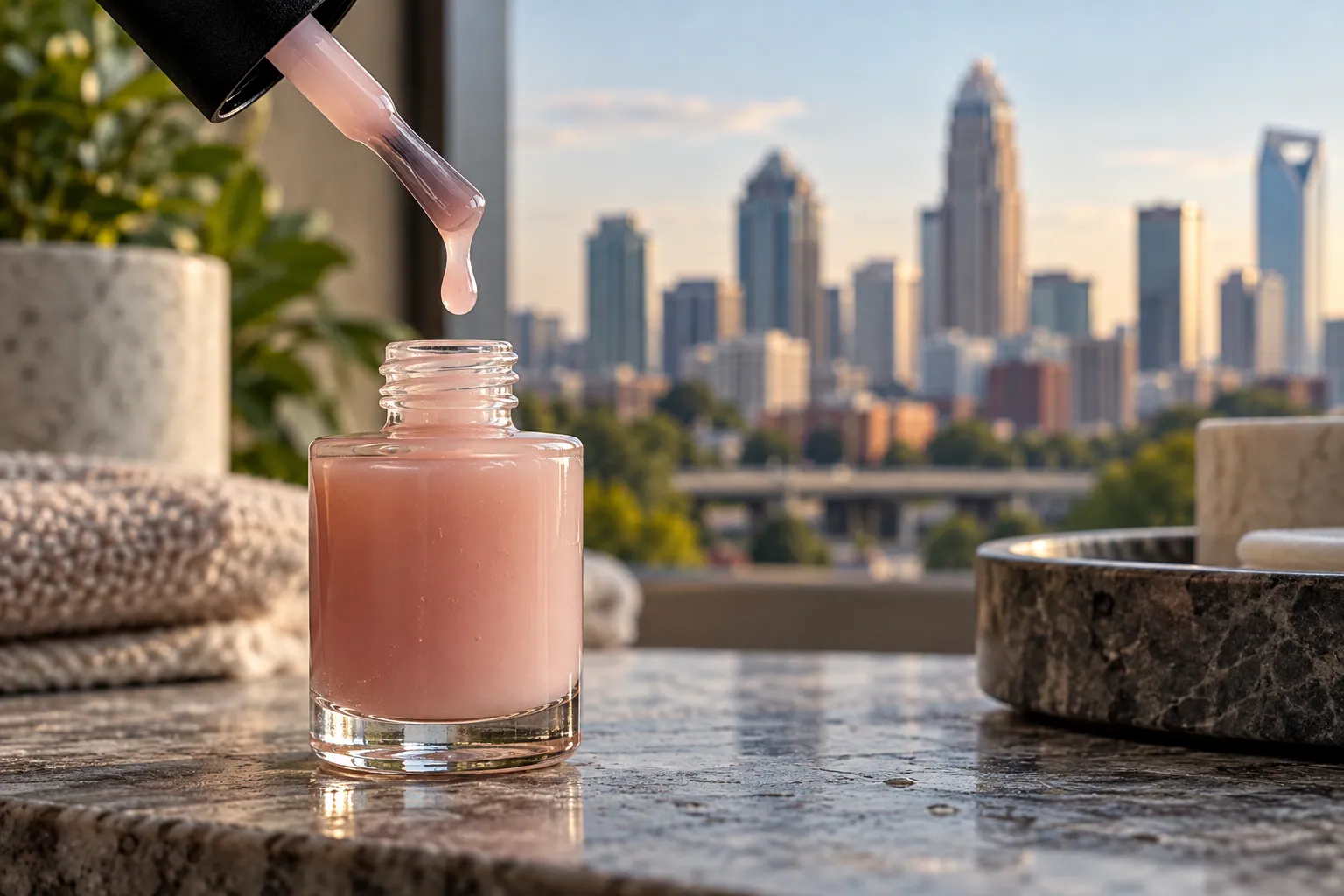
Heavy-bottom 15 ml amber glass bottle with high-viscosity suspended dropletBatch RB-982
Operator Verified Specification & Quote
$14 USD per 15 ml piece
Base coats span $7–$16 USD per piece across the studio catalogue. Rubber bases sit at $14 USD due to elastic monomer concentration and 15 ml volumetric packaging. Pricing quote depends on brand tier, bottle volume, and formulation longevity. No checkout cart; verified via direct inquiry.
Technician Testing Observation • Salon Practice Since 2022
In our Charlotte studio, low-viscosity bases fail on flexible nails because they cure rigid and snap along stress lines. Dense Rubber Base flexes synchronously with natural keratin plate deflection, preventing free edge micro-chipping over 14 to 21 days of heavy desk or manual work.
"My base coat always runs into the sidewalls before I can get the hand into the lamp, leaving flooding that lifts within forty-eight hours. How does dense rubber polymer behave differently?"
Glossiques Desk ReplyViscosity & Fluid Mechanics
Standard thin bases have viscosities near 2,000 mPa·s. They behave like water under ambient room temperatures: as soon as you touch the natural nail, capillary action pulls the wet gel directly into lateral nail folds and proximal cuticle tissue. Once gel touches the skin, polymerization forms a bridge that detaches the moment keratin sheds natural oils.
Dense Rubber Base is formulated at roughly 14,500 mPa·s. It acts like thick liquid resin. You place a slip layer of less than 0.1 mm across the plate, deposit a single apex droplet near the proximal third, and invert the finger for ten seconds. Gravity draws the center of the bead into a natural arch without edge pooling. You gain twenty to thirty seconds of working time before lamp curing without flooded sidewalls.
Our manicure master, in salon practice since 2022, tests every incoming lot using vernier calipers to measure droplet suspension before bottles are released to the catalog. We refuse to stock watered-down decants or formulas loaded with solvent thinners that compromise this mechanical stability.
Slip Layer ApplicationUltra-thin friction coat worked into keratin grooves
Apex Bead FormationSelf-levels ridge imperfections within 15 seconds
No, and anyone telling you that a single bottle replaces chemical preparation is setting your clients up for nail plate damage. Dense Rubber Base provides superior mechanical adhesion because its elastic polymer matrix matches natural keratin flex. However, it still requires thorough moisture dehydration and surface lipid removal.
We recommend pairing this base with an alcohol-based dehydrator followed by an acid-free bonding primer. Aggressive methacrylic acid primers etch deep grooves into the dorsal nail plate, causing severe onycholysis when used repeatedly. Dense Rubber Base bonds cleanly to a gently buffed 180-grit surface without acid burning.
Every bottle supplied by Glossiques is traceable to dated manufacturer certificates of product compliance. We inspect batch numbers, closure gaskets, and brush stem crimping so you never receive contaminated stock.
Client Objection • Tradeoff Consideration
"Can this dense base be soaked off in pure acetone within ten minutes like standard retail gel coats?"
It cannot, and that is a deliberate engineering tradeoff. The tight cross-linking that allows rubber base to withstand hot water, hand sanitizers, and computer keyboard impacts makes it resistant to rapid solvent penetration. A ten-minute acetone wrap will only soften the uppermost layer.
Safe removal requires either filing down 80% of the material with a 150/180 grit abrasive buffer or ceramic e-file bit, leaving a razor-thin protective base layer on the natural nail, or a 15 to 20 minute wrapped soak after fully breaking the top seal. If you want a quick five-minute peel-off product, this base is not for you. It is engineered for structural longevity.
Five-Stage Bench Standard
Sequential protocol for building a durable rubber base apex.
Following verified salon practice since 2022. Consistent prep and controlled flash curing prevent thermal spikes and perimeter detachment.
01
Mechanical & Chemical Dehydration
Gently refine the dorsal nail plate with a 180-grit buffer block. Remove residual dust with a lint-free spunlace wipe saturated in 99% isopropyl alcohol. Apply liquid dehydrator and wait 30 seconds until the surface chalks matte.
Tool: 100/180 bufferWipe: Spunlace non-wovenWait: 30 seconds air dry
02
Friction Slip Coat Deposit
Wipe excess base gel from the bottle brush. Work a microscopic layer of Dense Rubber Base into the plate using firm circular motions, leaving a 0.5 mm perimeter around cuticles. Do not cure yet.
Thickness: < 0.1 mmPerimeter: 0.5 mm marginState: Wet cushion
03
Apex Droplet Placement
Gather a medium bead on the tip of the brush. Place the bead at the proximal third of the nail plate. Guide the self-leveling gel down the central spine toward the free edge using the bristle tip without pressing into the wet slip coat.
Position: Proximal thirdMovement: Surface glideVolume: ~ 0.05 ml bead
04
Gravitational Inversion Alignment
Turn the client's hand palm-up for 5 to 10 seconds. Check the highlight reflection under a focused desk light to confirm a smooth, continuous convex curve from cuticle to tip before entering the lamp.
Cure for 60 seconds in a 48W UV/LED lamp. For heat-sensitive or thin nails, use the low heat mode (99s progressive power ramp) to prevent exothermic polymerization discomfort. Leaves an intact sticky dispersion layer ready for color lacquer.
Apparatus: 48W UV/LEDTime: 60 seconds standardDispersion: Do not wipe before color
Direct Inquiry • 130 North Tryon St
Inquire about Dense Rubber Base Coat or Studio Lots
All orders are handled via individual consultation. We do not use automatic web checkouts. Once submitted, our practicing nail technician will verify batch numbers, packaging seal integrity, and provide a non-binding invoice quote based on $14 USD per bottle.
Related Catalog Chemistries
Explore alternative base formulas and complementary coats
Microfiber Base
$15 USD
Reinforced synthetic silk microfibers embedded in 10 ml bottles for bridging micro-fractures on brittle free edges.
Acid-Free Base
$11 USD
Low-exotherm hypoallergenic bonding liquid in 8 ml format designed for hypersensitive natural nail beds.
Glass Shield Top
$16 USD
60-second UV/LED cured no-wipe top sealant providing 14+ days of wet-glass gloss over dense rubber foundations.
We use essential cookies and measurement technologies (including Google Ads Consent Mode v2 and Microsoft Advertising) to evaluate catalog inquiries. See our Cookie Policy.
Studio Desk • Live Channel
Glossiques studio desk is active. Inquire about nail polish formulas, base viscosities, brush shapes, or batch availability.